
industrial · Grangemouth
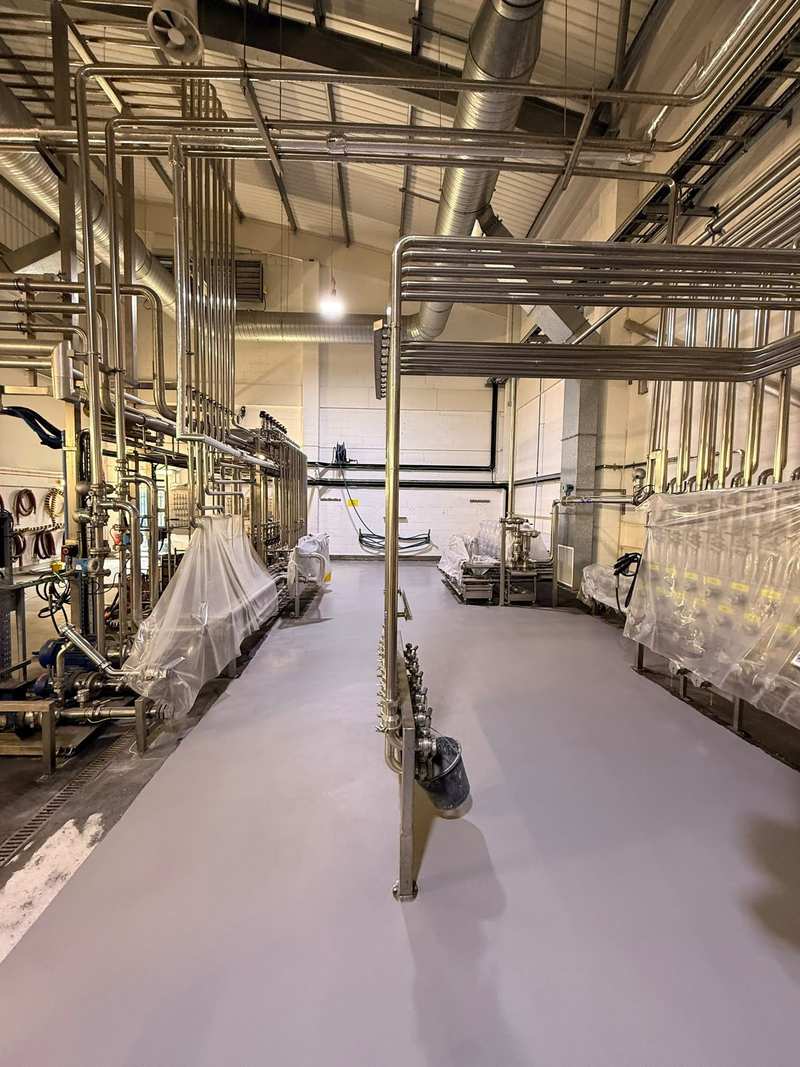
Polyurethane resin flooring at Whyte & Mackay, Grangemouth
Plant protected, concrete mechanically prepared and repaired, then a 9 mm Vebrocrete PU HF polyurethane system laid up to every plinth, frame and drain.

Dundee based · Scotland wide
A&B Building Solutions lays epoxy, polyurethane and MMA resin floors and repairs concrete floors for industrial, commercial and domestic clients across Scotland. We prepare the slab, repair cracks and joints, and lay a resin system chosen for the traffic, chemicals and cleaning regime on site, working from our base in Dundee.
 CHAS accredited
What we repair
The right resin depends on what the floor has to cope with. These are the main systems we lay.
Epoxy is the most widely used resin floor. It bonds strongly to prepared concrete, resists oils and many chemicals, and gives a hard, sealed surface that is easy to clean. It is laid as a thin coating for light traffic and dust-proofing, or as a thicker self-smoothing floor for warehouses and production areas.
Polyurethane screeds are laid thicker, usually several millimetres, and are built for hard wear. They tolerate hot wash-down, thermal shock and many food acids better than epoxy, which is why they are common in food and drink production. They also take impact from trolleys and dropped tools. At Whyte & Mackay in Grangemouth we laid about 285 m² of the 9 mm Vebrocrete PU HF system, a heavy-duty polyurethane floor, around fixed process plant.
MMA (methyl methacrylate) resins cure in a few hours, even at low temperatures. They suit external ramps, walkways and any floor that must reopen the same day. On the disabled access ramp at Aldi in Carluke we laid a three-coat MMA system with a full anti-slip aggregate in the final coat.
Grip comes from an aggregate broadcast into the resin. A fine grade suits areas that need frequent cleaning. Coarser grades suit ramps, wet process areas and external walkways.
Project example

The concrete under fixed stainless steel plant was prepared and resin-coated without moving the equipment, leaving a sealed floor that runs tight to every frame and drain.
Have a similar resin flooring project?
Enquire about your repairProcess areas need floors that seal the concrete, resist spills and wash down cleanly, laid tight to drains, plinths and frames so dirt has nowhere to collect. On a recent process plant floor, the plant stayed in place. We sheeted it in polythene, mechanically prepared the concrete and laid two resin finishes around the pipe racks and valve manifolds.
Warehouse floors take constant forklift and pallet truck traffic. Worn joints, dusting concrete and broken arrises are the usual problems. We repair the slab and joints, then lay a self-smoothing epoxy or polyurethane floor.


An epoxy coating seals a garage or workshop floor against oil, tyre marks and dust. Preparation matters as much as on an industrial floor. The concrete is ground to remove laitance and old paint, cracks are filled, and a damp slab is checked before a primer goes down. We then lay the epoxy, with an anti-slip finish if needed.

Most resin floor failures start with the concrete underneath, so we repair the slab before any resin goes down. Typical defects are cracked and settled slabs, broken joint edges where wheels cross, hollow or dusting surfaces, and areas eroded by chemicals or wear. We cut out and rebuild failed joint arrises with a resin or polymer repair mortar, fill or inject cracks, and patch damaged areas back to level. Where a floor needs repair only, we carry out the repairs on their own and seal the concrete.
Concrete Floors, Slabs & Screeds
Where a floor is beyond repair, or a new area is being formed, we lay new concrete slabs and screeds. A screed gives a level, flat surface on top of a structural slab, ready for a resin finish or floor covering. Sand and cement screeds suit most areas. Liquid screeds flow to a level surface and are often used over underfloor heating. New slabs and screeds must dry before resin can go on, so the programme allows for drying time or a moisture-tolerant primer.
Our approach
We check the slab for moisture, strength, cracks, joints and contamination, and agree the traffic, chemicals and cleaning regime.
We set the resin system, thickness, anti-slip grade and return-to-use time.
The concrete is ground or shot blasted to remove the weak surface layer and give the resin a key.
Cracks, joints and damaged areas are repaired and brought back to level.
Primer, body coats and finish coat are laid, with aggregate broadcast where grip is needed.
The floor is left to cure for the time the system requires before traffic.
Who we work with
Food, drink and process plants, warehouses, workshops and factories need floors that take forklift and pallet traffic, resist spills and wash down cleanly, and go down with as little downtime as possible. We work around fixed plant and to the site's permit and induction rules, and we are CHAS accredited.
Commercial clients, such as retailers, car parks and public buildings, usually need anti-slip finishes on ramps, entrances and walkways, often laid in short closures.
We also lay epoxy floors in domestic garages and workshops.
Project costs
The cost of a resin floor depends on the system, the floor area, and the state of the concrete underneath. A thin epoxy coating on a sound slab is at the lower end. A thick polyurethane screed on a damaged floor that needs grinding, crack repair and new joints is at the higher end.
Access, working hours, moisture in the slab, anti-slip aggregate and coving also affect the price. We quote from a survey, with the system, thickness and preparation listed, so quotes can be compared like for like.
Projects
industrial · Grangemouth
Plant protected, concrete mechanically prepared and repaired, then a 9 mm Vebrocrete PU HF polyurethane system laid up to every plinth, frame and drain.

commercial · Carluke
Concrete repairs in Sika Monotop 630 Rapid, then a three-coat MMA resin system with a full anti-slip aggregate.

Excellent service and work, they done a great job fixing my chimney, they were very prossional and friendly. I wouldnt hesitate in using them again
Frequently asked questions
Resin flooring is the general name. Epoxy is one type of resin, and the most common. Polyurethane and MMA are others. Each has different strengths, so the right one depends on the traffic, chemicals, temperature and how fast the floor must be back in use.
It depends on the system, the thickness and the preparation the slab needs. We price each floor from a survey and list what is included, so the figure is for your floor.
It depends on the resin. MMA systems cure in a few hours, even in the cold. Epoxy and polyurethane systems usually take foot traffic the next day and need longer before full vehicle traffic. We set the return-to-use times in the programme before work starts.
Often, yes, if the existing floor is sound and well bonded. Old coatings, oil contamination and damp slabs need treatment first. The survey tells us what preparation is needed.
Yes. On a process plant floor we sheeted the plant in polythene and laid the resin up to every frame, manifold and drain without moving the equipment.
A smooth resin floor can be. Broadcasting an aggregate into the final coat gives a textured, slip-resistant finish. We choose the grade of aggregate for the area, balancing grip against ease of cleaning.
Where we work
We lay resin floors across Scotland from our base in Dundee, including Dundee and Angus, Perth and Perthshire, Fife, Aberdeen and Aberdeenshire, Edinburgh and the Lothians, Stirling, Glasgow and the Central Belt.
Related services

Repair solutions for cracked, damaged and deteriorating concrete and structures.

Building and façade repairs for commercial properties and managed estates.

Specialist systems to address water ingress and protect below-ground spaces.
Start a conversation
Tell us about the issue, location and timescale. Photos help. We'll get in touch to discuss the next steps.

CHAS accredited contractor.
2n Thorter Way, Dundee DD1 3AY.